Why every food business from a home baker to a cloud kitchen to a packaged food brand needs FSSAI, and what happens when they skip it.
There is a quiet moment in every food entrepreneur's journey that decides everything.
It is not the day the first order comes in. It is not the day the first review goes up. It is the day a customer turns the package around, looks at the back, and silently checks for one thing: a fourteen-digit number.
That number is the FSSAI license.
And in 2026, it is no longer a regulatory formality. It is the single line on a label that decides whether a customer trusts you, whether a marketplace lists you, whether a quick-commerce app delivers you, and whether the government leaves you alone.
You can have the best recipe in the city. You can have the prettiest packaging in your category. But if that fourteen-digit number is missing, you do not have a food business. You have a hobby with legal risk attached.
What FSSAI Actually Is (And Why It Refuses to Be Ignored)
FSSAI stands for the Food Safety and Standards Authority of India. It was created under the Food Safety and Standards Act, 2006, and given one job: make sure that anything sold as food in India is actually safe to eat.
That sounds simple until you realise how wide the net is. FSSAI does not just regulate factories and brands. It regulates anyone who manufactures, processes, packages, stores, distributes, transports, imports, or sells food.
That includes:
- The home baker selling brownies on Instagram
- The cloud kitchen running three menus from one address
- The tiffin service feeding a tech park
- The packaged snacks brand
- The dairy unit, the spice mill, the cold storage, the food truck
- The supermarket, the kirana store, the caterer at weddings
- The importer bringing in olive oil or the exporter shipping out pickles
If food touches your hands or your books, FSSAI applies.
The only question is which kind of approval you need.
The Three Doors: Registration, State License, Central License
FSSAI sorts food businesses into three categories based mostly on annual turnover. And here is where most owners get confused because the thresholds were rewritten in 2026.
Effective 1 April 2026, the new categorisation is:
1. Basic Registration -- for businesses up to ₹1.5 crore turnover
This is the entry-level approval. Home kitchens, small retailers, neighbourhood stalls, tiffin services, petty manufacturers the vast majority of small food businesses in India fall here.
Documentation is light. Approval is fast. Many small businesses now get instant registration without inspection.
2. State License -- for businesses between ₹1.5 crore and ₹50 crore turnover
This is the mid-tier. Restaurants, mid-scale processors, distributors, single-state chains. Issued by the state food safety authority. Heavier paperwork, premises inspection, but still manageable.
3. Central License -- for businesses above ₹50 crore turnover
This is the top tier but the surprise is this: turnover is not the only trigger. You also need a Central License regardless of turnover if you are:
- An importer or exporter of food
- An e-commerce food seller or food platform
- A nutraceutical or health supplement manufacturer
- A 5-star or above hotel
- Operating at airports, seaports, or central government premises
- Running units in more than one state (the head office needs a Central License)
A small importer doing ₹40 lakh in business needs a Central License. A factory doing ₹45 crore in one state only needs a State License. Turnover tells half the story. The nature of the business tells the rest.

Why That 14-Digit Number on Every Package Matters
Every FSSAI license carries a unique fourteen-digit number. By law, that number must appear on the food product label, on the business premises, and on invoices.
It is not decoration. It is a public declaration: this food has been registered with the regulator, the business can be traced, and someone is accountable if something goes wrong.
Customers in 2026 have learned to look for it. Marketplaces refuse to list food products without it. Quick-commerce platforms reject on boarding without it. A missing FSSAI number on a label is no longer "an oversight." It reads as a warning.
The 2026 Reforms: What Changed, and Why It's Mostly Good News
The April 2026 amendments brought four big shifts that every food business owner should know:
Perpetual validity. Licenses and registrations issued from 1 April 2026 onwards no longer expire. You do not need to renew every one, three, or five years. Annual fees still apply, but the constant renewal anxiety is gone.
Higher turnover thresholds. A business doing ₹1 crore in turnover that previously needed a State License can now operate on a Basic Registration. That is a meaningful reduction in cost, paperwork, and inspection load for tens of thousands of small businesses.
Risk-based inspections. Inspections are no longer triggered by a fixed calendar. They are now driven by food category risk, compliance history, and audit performance. Compliant businesses get left alone. Repeat offenders get visited often.
Deemed registration for street vendors. Vendors already registered under the Street Vendors Act, 2014 are now automatically considered FSSAI-registered. No duplicate paperwork.
The headline is simple: compliance got lighter for the small, sharper for the careless.
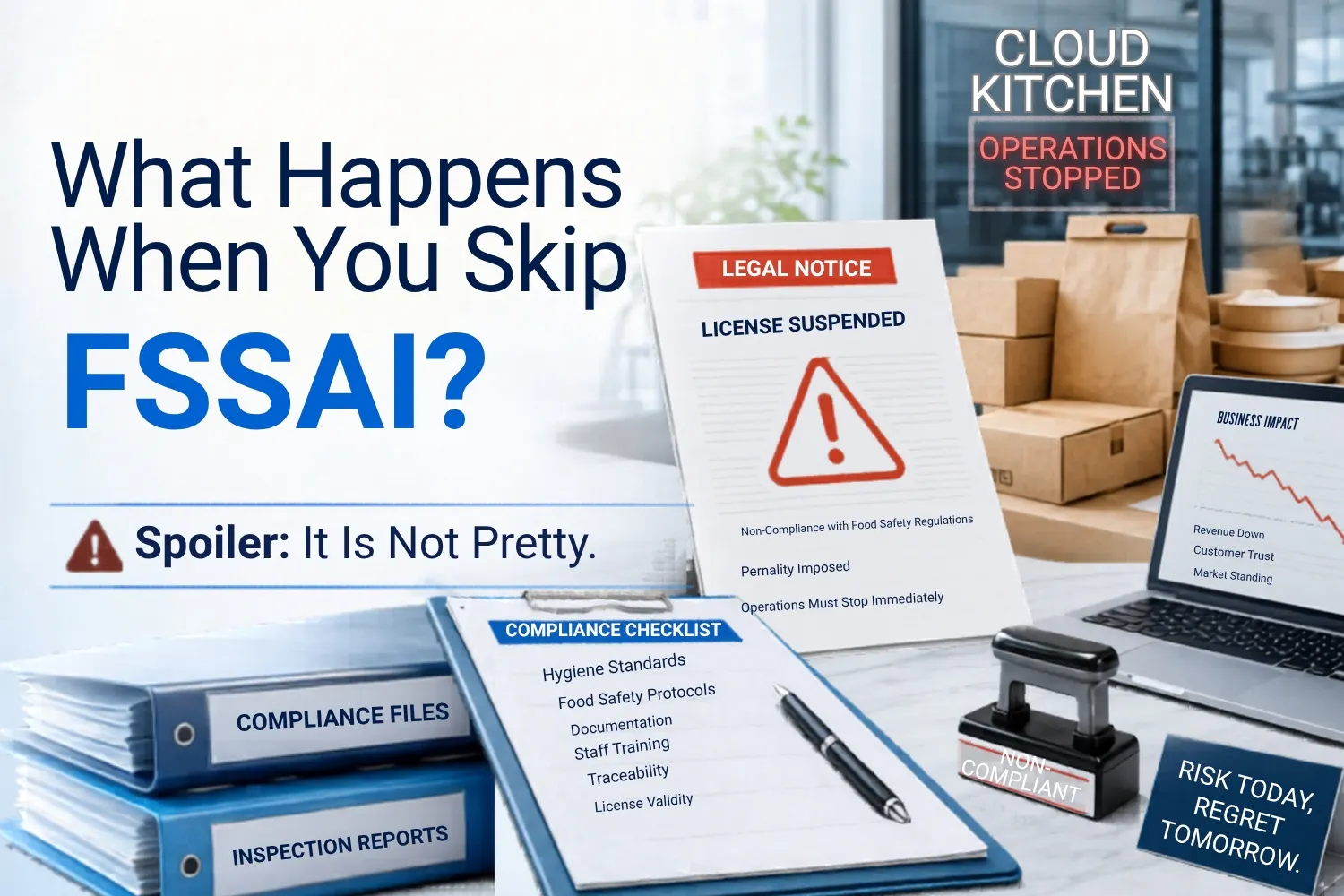
What Happens When You Skip FSSAI (Spoiler: It Is Not Pretty)
Some food entrepreneurs treat FSSAI as a "later" problem. Get the business running first. Get the licence lacter. In 2026, "later" is an expensive word.
Running a food business without the required FSSAI registration or license can attract a fine of up to ₹5 lakh and imprisonment of up to six months under the FSS Act. Misbranded or misleading labels carry their own penalties. Substandard food can be fined up to ₹5 lakh. Unsafe food that causes injury can attract heavier fines, imprisonment, and in extreme cases, life imprisonment.
The legal consequences are real, but they are rarely what kills the business. What kills the business is everything that quietly stops working:
- Marketplaces delist the product. Amazon, Flipkart, Blinkit, Zepto, Swiggy Instamart none of them will keep a food listing live without a valid FSSAI license.
- Payment gateways and aggregators flag the account. Food category KYC almost always includes FSSAI verification now.
- Customer’s screenshot the missing license number and post it online. Reputation damage spreads faster than any fine ever could.
- Investors and buyers walk away during due diligence. No serious investor signs a cheque for a food business with a compliance gap.
- Insurance claims get denied. Product liability cover often requires valid FSSAI status.
The fine is the part you see. The lost revenue is the part you do not.
The Categories That Trip Up Modern Food Businesses
The new wave of food entrepreneurs cloud kitchens, D2C brands, home bakers, ghost kitchens, health supplement sellers often misread their own category. A few common traps:
The home baker who thinks they are too small. If you sell food, you need at least a Basic Registration. There is no "I only do weekends" exemption.
The cloud kitchen running multiple brands from one address. Each kitchen still needs a license tied to that premises. Multiple brands do not mean multiple licenses, but the address must be covered.
The D2C brand that ships across states. The moment you operate from more than one state, the head office needs a Central License
regardless of turnover.
The supplement seller who thinks "wellness" is a different category. Nutraceuticals, health supplements, and Ayurveda Aahara products need a Central License from day one. Turnover does not matter.
The exporter and the importer. Both need Central Licenses. Even at low turnover. No exceptions.
The Instagram seller using a kitchen they do not own. The licensed premises and the actual cooking premises must match. A license cannot be borrowed.
Where NextGen Comes In
Most food entrepreneurs do not have a problem understanding that FSSAI matters. They have a problem figuring out which category they fall into, which form to fill, which documents to collect, and how to keep the license clean once it is issued.
That is where NextGen steps in. We help food businesses identify the right FSSAI category, prepare the documentation, file through the FoSCoS portal, manage premises inspections, handle modifications when the business changes, and stay ahead of the compliance calendar including annual fees, return filings, and labelling rules.
We do not just file the application and disappear. We treat FSSAI as part of your operating system
so your marketplace listings stay live, your label is always correct, your inspections go smoothly, and you never wake up to a frozen payout or a delisted product.
The Compliance Formula for Food Businesses in 2026
If you take nothing else from this piece, take these five practices.
1. Get the Category Right Before You Apply
A wrong category causes a rejected application, wasted fees, and weeks of delay. Map your turnover, your premises, your geography, and the nature of your product to the correct tier before filing.
2. Put the License Number on Everything
Label, packaging, invoice, website footer, marketplace listing, social media bio if you sell there. The fourteen-digit number is your most public compliance signal. Use it.
3. Treat Hygiene as a System, Not an Event
Perpetual validity does not mean perpetual immunity. Risk-based inspections will visit any business that looks careless. SOPs, pest control records, FSSAI training certificates, and clean documentation are the things that survive an inspection.
4. Update Your License When Your Business Changes
New address. New product category. New state of operation. New turnover band. Every one of these is a modification, not a renewal. Filing them late is what turns a clean license into a flagged one.
5. Build Compliance In Before You Scale
Marketplace expansion, exports, new manufacturing units, contract manufacturing every one of these has a compliance step attached to it. Build it in early. Retrofitting compliance after a brand has taken off is always more expensive than doing it on day one.
The Bottom Line
The food business in India has never been more open. Anyone with a recipe, a phone, and a kitchen can start selling tomorrow. The barrier to entry has collapsed.
But the barrier to survival has not.
FSSAI is the line between a food business that grows and a food business that gets shut down. It is the line between a product that sits on a Blinkit shelf and one that gets quietly delisted overnight. It is the line between a brand that customers trust and one they screenshot for the wrong reasons.
You are not paying for paperwork when you register with FSSAI. You are paying for the right to be taken seriously in a market where everyone else is being checked.
The food business of 2026 has many winners. Every one of them has the same fourteen-digit number on the back of the pack.
Ready to get your FSSAI in order?
NextGen helps food businesses across India identify the right license category, file the application, manage inspections, and stay compliant year after year without the paperwork stress.
✔️ Right category, first time
✔️ Documentation and FoSCoS filing handled end-to-end
✔️ Label and premises compliance reviewed
✔️ Long-term compliance support, not just one-time filing
Let's make sure your food business is built to last.

Book a Free Consultation!
Ready to Win the Buy Box & Scale Your E-commerce Business?
Join sellers who are already building predictable, profitable growth.
✔️ Improve your rankings
✔️ Increase conversions
✔️ Build a sustainable e-commerce business
Let’s make your store work smarter not harder.
Free consultation • Fast response
Let’s discuss your growth plan
Share your requirements and we’ll suggest the best next steps for your store, ads, and performance.
- Store & catalog review
- Ads & ROAS audit
- Setup & onboarding
- Actionable roadmap
Prefer email? care@nbsspl.com