For years, the economics of Indian e-commerce were simple from a customer's point of view:
You pay for the product. The seller pays the marketplace.
But that equation is quietly changing.
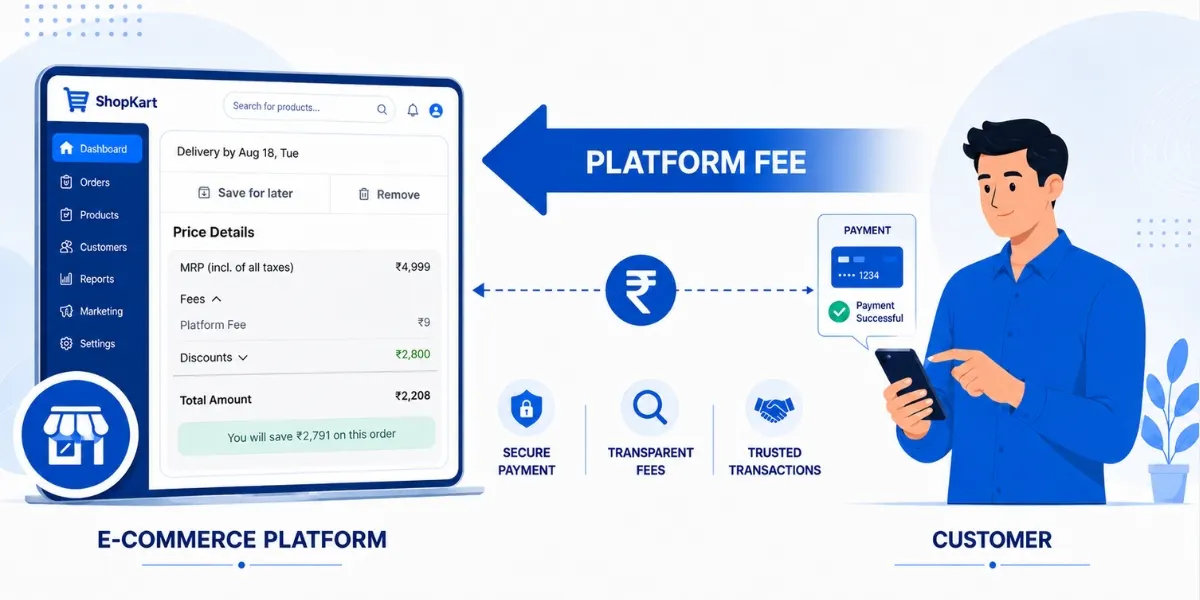
Today, customers increasingly see a separate "platform fee" or "marketplace fee" added to their checkout bill. Amazon, Flipkart, and Myntra have all been associated with customer-facing platform charges though the amount and applicability differ by platform, order, and customer.
Amazon, for example, introduced a ₹5 marketplace fee (inclusive of tax) on orders back in mid-2025, with exceptions for certain categories like gift cards, digital services, and B2B orders. It even applies to Prime members. Amazon says the fee helps support the marketplace experience.
So the real question isn't "Why am I paying ₹5 extra?"
The real question is:
Why are e-commerce platforms shifting part of their monetisation from sellers to customers?
And for anyone selling online in India, the answer matters more than the ₹5 itself.
What Exactly Is a Platform Fee?
A platform fee (or marketplace fee) is a charge the marketplace collects from the customer for facilitating the transaction and maintaining the marketplace ecosystem.
It is different from all the charges sellers already know: product price, GST, delivery charges, convenience charges, seller commissions, and advertising fees.
Think of it this way:
- Product price = what you buy
- Delivery fee = what it costs to deliver
- Platform fee = what the platform charges for facilitating the marketplace transaction
The amount looks small. But across millions of orders, even a tiny customer-side fee becomes a meaningful revenue stream.
1. E-commerce Is Becoming a Mature Business
Indian e-commerce platforms spent years prioritising customer acquisition and transaction growth. Low prices, free delivery, discounts, and seller incentives built the shopping habits we now take for granted.
But once a platform reaches serious scale, the focus gradually shifts from "How do we get more orders?" to "How do we make every order economically sustainable?"
A small customer-side platform fee becomes one more monetisation lever.
2. Seller Economics Are Also Changing
Here's where it gets interesting for sellers.
Platforms aren't simply raising every seller charge. In fact, Amazon announced significant seller-fee changes effective March 16, 2026 expanding zero referral fees to products priced up to ₹1,000 across 1,800+ categories (over 12.5 crore products), reducing Easy Ship fees for low-priced items, and cutting certain fulfilment and closing fees. Sellers can save up to 70% in total selling fees on eligible products. Flipkart's structure, too, mixes fixed fees, commission fees, and fulfilment-related charges.
Recent competition between Amazon and Flipkart has actually involved reducing some seller fees to attract sellers especially around lower-priced products.
That creates a fascinating strategic shift:
Platforms can cut selected seller-side costs while simultaneously creating new customer-side revenue.
The marketplace no longer has to monetise only the seller.
3. A ₹5 Fee Is More Powerful than It Looks
A simple illustration. Suppose a platform processes 10 million orders a month and collects an average ₹5 platform fee per order.
That's ₹5 crore a month roughly ₹60 crore a year.
(This is a hypothetical illustration, not a claim about any platform's actual volumes or revenue.)
The lesson is simple:
Small fee × huge transaction volume = meaningful monetisation.
4. It Reduces Dependence on Seller Monetisation
Marketplace businesses traditionally earn through several channels: seller commissions, advertising, logistics and fulfilment, subscriptions, and other services. A customer-facing platform fee simply adds another stream.
That diversification matters. If a platform keeps seller commissions low to attract more sellers, it can recover economics elsewhere a real advantage in India's fiercely competitive marketplace environment, where Amazon, Flipkart, Meesho and others compete aggressively for both sellers and customers.
But Isn't This Bad for Customers?
Not necessarily. There are two sides.
The platform's view: running a marketplace means paying for technology infrastructure, search and recommendation systems, payments, fraud prevention, customer support, order processing, logistics integration, returns, and seller on boarding. A separate fee helps recover part of these costs while keeping product prices competitive.
The customer's view: the problem is fee fatigue.
Imagine a product listed at ₹499. Then checkout shows:
- ₹499 — Product
- ₹18 — Delivery
- ₹5 — Platform fee
- ₹94 — GST
Suddenly, the "₹499 deal" doesn't feel like ₹499 anymore.
Customers don't evaluate the product price alone. They evaluate the final checkout price.
And that shift changes everything for sellers.
What This Means for Sellers
This is where the story becomes essential for anyone selling on Amazon, Flipkart, or Meesho.
A platform fee is not automatically a seller cost. If the marketplace charges the customer separately, the seller may not directly lose ₹5 from the selling price.
But the indirect impact is real.
Suppose two marketplaces show the same product:
- Marketplace A: ₹499 final price
- Marketplace B: ₹499 + platform fee
Even a small difference in the final payable amount can influence conversion rate, cart abandonment, price perception, repeat purchases, and marketplace preference because Indian shoppers are among the most price-sensitive in the world.
So sellers need to stop thinking only about "What is my selling price?" and start thinking about "What is the customer's final landed price?"
Could Platform Fees Change Seller Pricing?
Potentially, yes.
Imagine two sellers offering an identical product at ₹499. If one platform adds a customer-side fee at checkout, that customer's final price is higher. The seller may respond by trimming the product price slightly to stay competitive.
That creates a chain reaction:
Platform fee → higher customer checkout price → conversion pressure → seller pricing response
So even when the seller doesn't directly pay the fee, customer-side charges can quietly reshape seller pricing strategy.
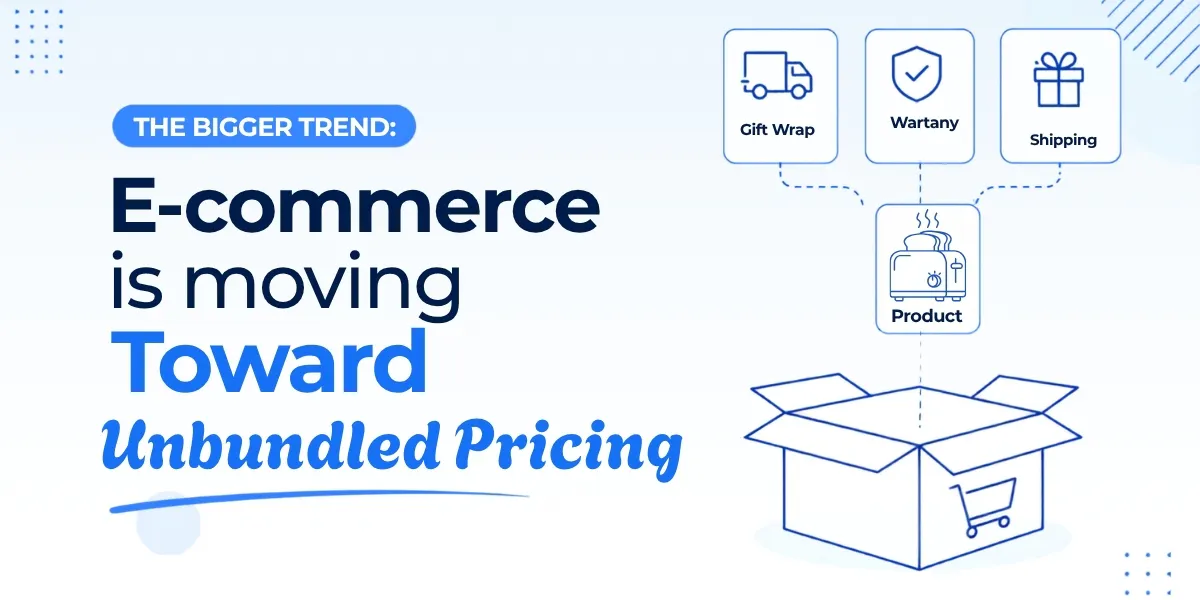
This isn't unique to e-commerce. Across digital businesses, consumers increasingly meet a stack of separate charges:
Base price + service fee + convenience fee + delivery fee + platform fee.
The advantage for businesses is transparency about where revenue comes from. The disadvantage? Too many small charges create the feeling that the advertised price isn't the real price and as competition intensifies, that perception becomes a genuine risk.
What Should Indian Sellers Watch?
If you're selling on marketplaces, don't just track commission changes. Track these five things:
1. Final customer price:-monitor what the customer actually pays, not just your catalogue price.
2. Conversion rate: - if platform fees raise the final checkout amount, watch whether conversions move.
3. Competitor pricing: - compare the final payable price, not merely the listed product price.
4. Marketplace-specific economics: - a lower seller commission doesn't automatically mean higher profit if customer-side economics hurt conversion.
5. Customer behaviour: - watch whether buyers consolidate orders, wait for free-delivery thresholds, or switch marketplaces based on final checkout prices.
The Real Question Isn't ₹5
A ₹5 platform fee looks insignificant to an individual customer. Strategically, it represents something far bigger.
Indian e-commerce is entering a phase where platforms are actively experimenting with who pays for the marketplace ecosystem, and how. For years, sellers were the primary monetisation engine. Now customers are being pulled into that equation too.
And for sellers, that means one thing:
Don't analyse marketplace fees only from the seller dashboard. Start analysing them from the customer's checkout screen.
Because in e-commerce, the fee the seller doesn't pay can still influence the price the customer sees and ultimately, whether the customer buys at all.
How NextGen Helps Sellers Navigate the New Fee Economics
Fee structures on Amazon and Flipkart are shifting faster than most sellers can track zero referral fees one quarter, a new customer-side charge the next, a tweak to fulfilment or closing fees the quarter after that. For a small seller already juggling inventory, orders, and returns, keeping up with every policy update is nearly impossible and chasing each change one at a time is a losing game.
The sellers who stay ahead don't win by reacting faster. They win because their business already knows its real numbers before the next change lands. When you know your true cost per order and your actual margin after every fee, a new ₹5 charge or a referral-fee cut stops being a shock it becomes just another input you can price around.
The Bottom Line
For years, the deal was straightforward: customers bought, sellers paid the marketplace. That era is ending. Platform fees, seller-fee cuts, and unbundled pricing are quietly rewriting who funds the Indian e-commerce ecosystem and every seller is affected, whether they realise it or not.
The winners won't be the sellers with the lowest catalogue price. They'll be the ones who understand their full cost structure, watch the customer's checkout screen as closely as their seller dashboard, and price with real numbers instead of guesswork.
Because the next competitive advantage in Indian e-commerce may not be the lowest product price.
It may be the lowest final checkout price.
Book a Free Consultation!
Ready to Win the Buy Box & Scale Your E-commerce Business?
Join sellers who are already building predictable, profitable growth.
✔️ Improve your rankings
✔️ Increase conversions
✔️ Build a sustainable e-commerce business
Let’s make your store work smarter not harder.
Free consultation • Fast response
Let’s discuss your growth plan
Share your requirements and we’ll suggest the best next steps for your store, ads, and performance.
- Store & catalog review
- Ads & ROAS audit
- Setup & onboarding
- Actionable roadmap
Prefer email? care@nbsspl.com