Every GST registration in India begins with one deceptively simple question: "What is your Principal Place of Business?"
For a shop owner with a single store, the answer is obvious. But for today's e-commerce sellers, consultants, and startups working from home, co-working spaces, or multiple warehouses, this one field on the GST portal can decide whether your registration sails through or gets stuck in queries and rejections.
This blog breaks down what PPOB really means, how it differs from an Additional Place of Business (APOB), what documents you need, and why getting it right matters more than most businesses realise.
"Your PPOB is not just an address. It is the legal identity of your business in the eyes of the GST department."
What is Principal Place of Business (PPOB)?
The Principal Place of Business (PPOB) is the primary location within a state from which a business carries out its core operations. It is the address you declare as your main place of business while applying for GST registration, and it becomes the official address linked to your GSTIN.
Under GST law, the PPOB is typically the place where:
- Books of accounts and business records are maintained
- Key management and administrative decisions are taken
- Official communication from the GST department is received
- The day-to-day running of the business is coordinated
The legal foundation comes from Section 2(85) of the CGST Act, 2017, which defines a "place of business" broadly it includes any place from where business is ordinarily carried on, a warehouse or godown where goods are stored or supplied, and any place where books of accounts are kept.
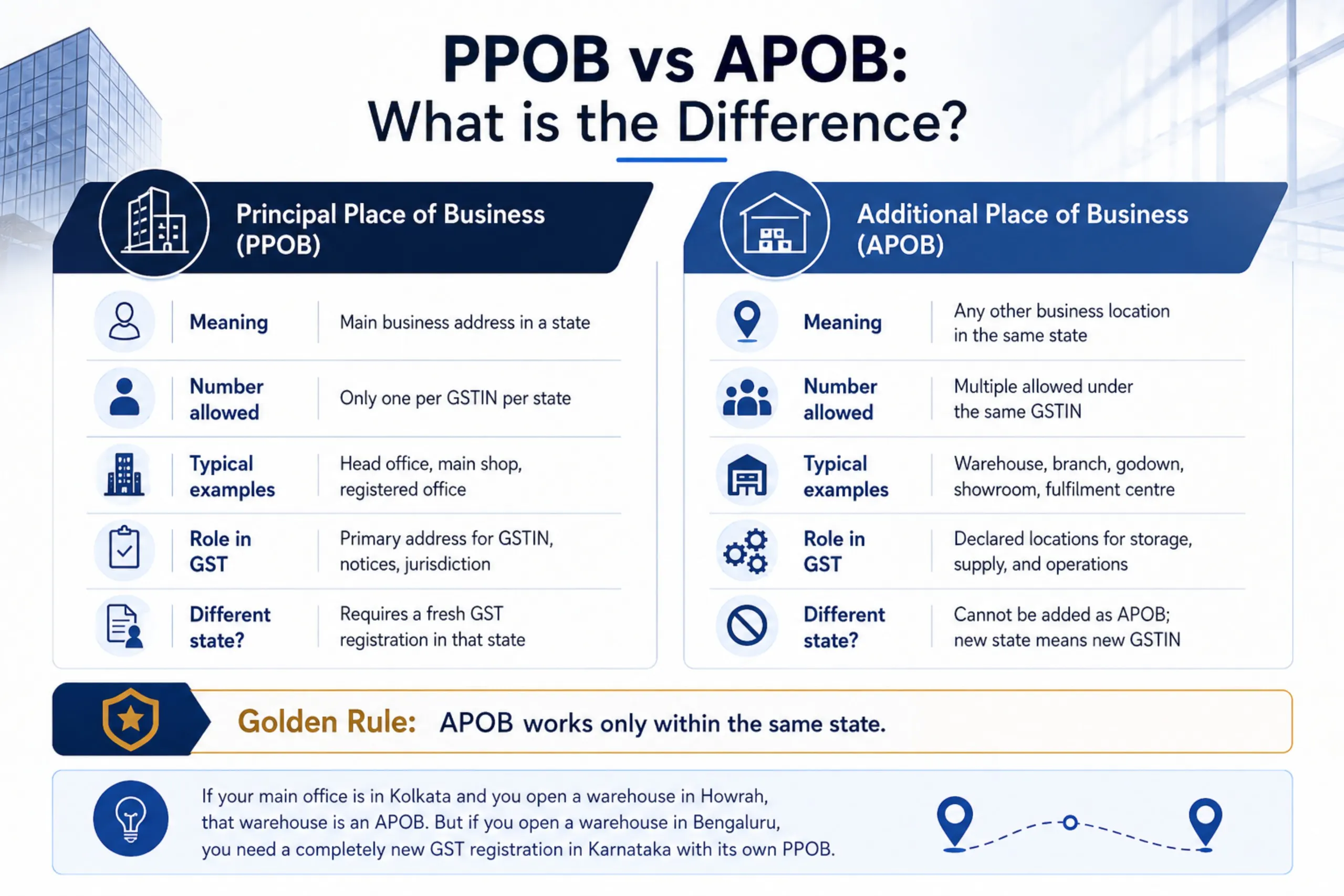
Each GST registration can have only one PPOB per state. Every other business location in that same state is treated as an Additional Place of Business (APOB).
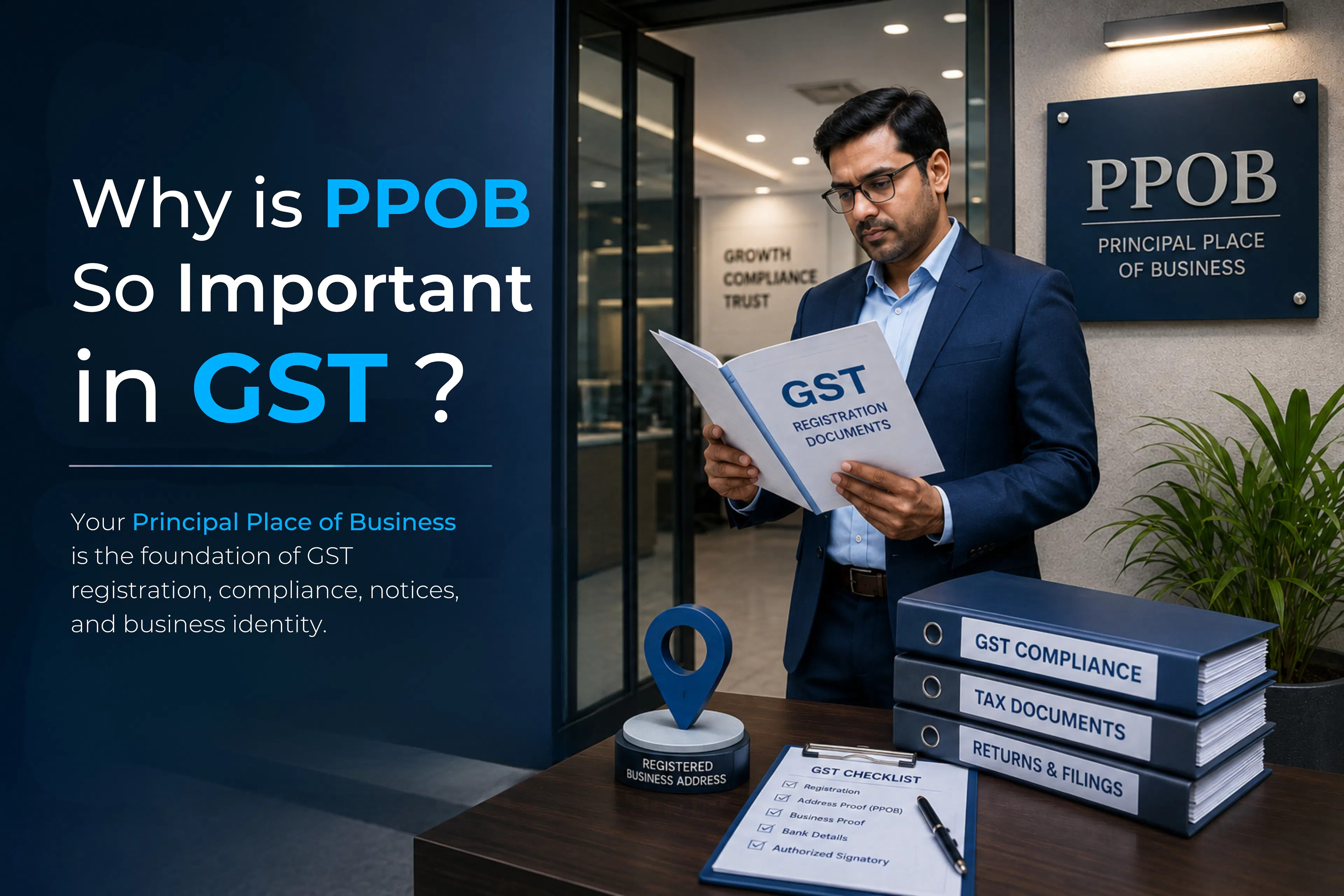
Why is PPOB So Important in GST?
The PPOB is far more than a formality. It determines several critical aspects of your GST compliance:
1. Jurisdiction: Your PPOB address decides which GST officer and tax jurisdiction your business falls under. All assessments, notices, and inspections flow from this.
2. GSTIN Allotment: Your GST Identification Number is issued against your PPOB address in that state. It becomes the anchor of your tax identity.
3. Official Communication: Notices, clarifications, and departmental correspondence are sent to the PPOB. A wrong or unreachable address can mean missed notices and missed notices can escalate into penalties or cancellation.
4. Return Filing and ITC: GST returns are filed state-wise based on where your PPOB is registered. Correct declaration of all business places also protects your Input Tax Credit claims.
5. Physical Verification: GST officers may visit the declared PPOB for verification. If the address does not match reality no signboard, no records, no occupancy proof the registration can be questioned or rejected.
A mismatch between your declared PPOB and your actual operations is one of the most common reasons for GST registration rejection in India.
What Documents are required to Declare a PPOB?
The documents depend on how you occupy the premises:
- Owned property: Latest property tax receipt, municipal khata copy, or electricity bill in the owner's name
- Rented property: Registered rent/lease agreement plus a utility bill of the premises
- Shared or consent-based premises: No Objection Certificate (NOC) or consent letter from the owner, along with their ownership proof
- Virtual office: Agreement with the service provider, NOC, and utility bill of the premises
Along with address proof, businesses typically submit PAN, Aadhaar, photographs of the proprietor/partners/directors, and constitution documents (partnership deed, certificate of incorporation, etc.).
Can a Virtual Office be Used as PPOB?
Yes, and this is where PPOB becomes especially relevant for modern businesses. A virtual office is a legally recognized business address rented from a service provider, complete with the documentation GST authorities require: rent agreement, NOC, and utility bills.
Virtual offices are widely used as PPOB or APOB by:
E-commerce sellers who must register in multiple states to store inventory in marketplace fulfilment centers
- Startups and freelancers operating remotely without a physical office
- Service businesses expanding into new states without committing to expensive leases
For a seller in West Bengal who wants to store goods in an Amazon or Flipkart warehouse in Maharashtra, a virtual office in Maharashtra can serve as the PPOB for the new state registration making multi-state expansion possible without renting full-fledged offices everywhere.
"For e-commerce sellers, the PPOB question is not a one-time formality it repeats in every new state they expand into."
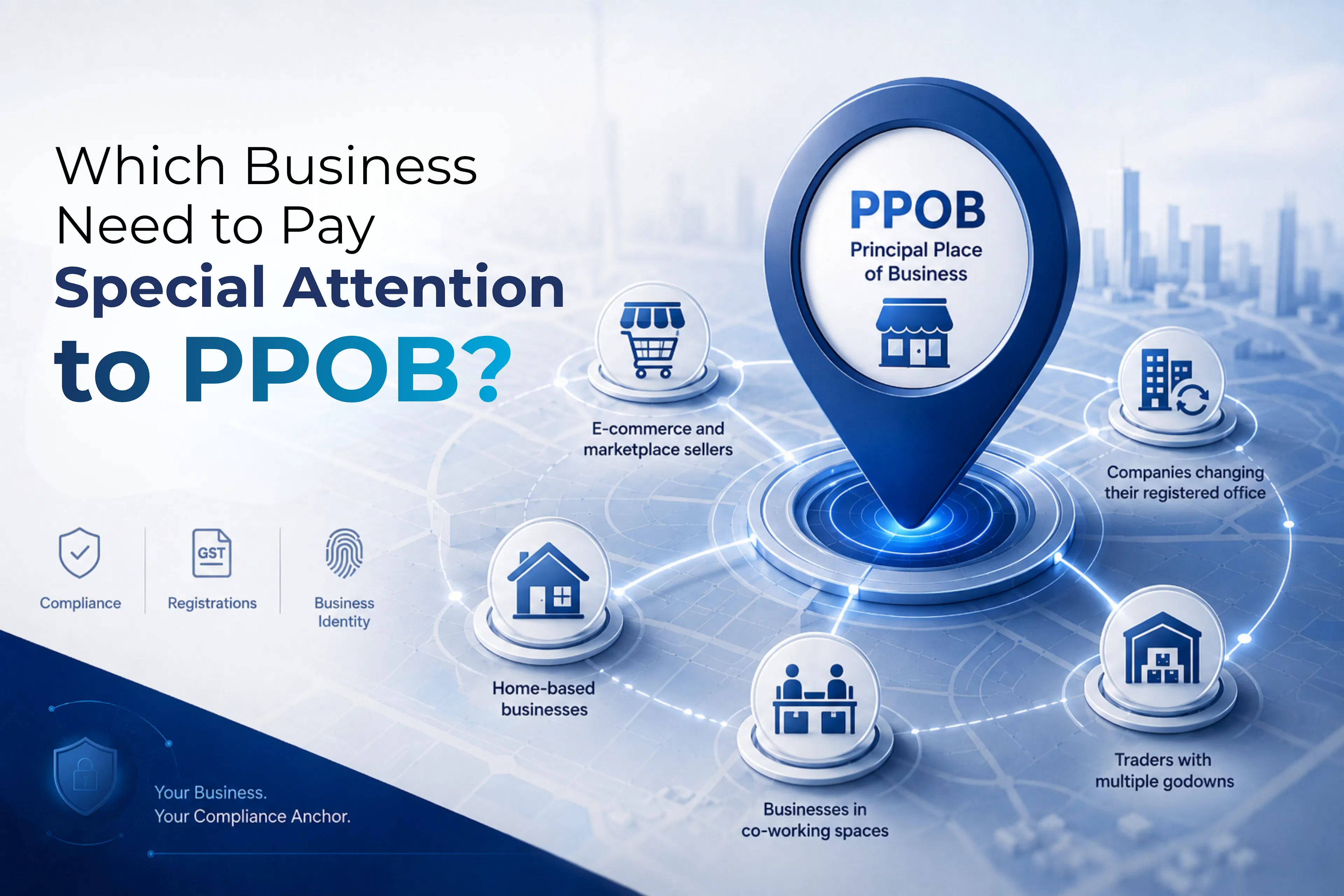
- E-commerce and marketplace sellers: Multi-state operations mean multiple PPOBs across states, each with its own documentation.
- Home-based businesses: Residential addresses can be declared as PPOB, but require proper ownership/consent proof.
- Businesses in co-working spaces: Need agreements and NOCs from the space provider.
- Traders with multiple godowns: Must correctly split locations into one PPOB and the rest as APOBs.
- Companies changing their registered office: Any change in PPOB must be amended on the GST portal, generally within 15 days of the change.
Common Mistakes Businesses Make with PPOB
- Declaring an address without valid proof leading to queries, delays, or rejection.
- Confusing PPOB with APOB :- trying to add an out-of-state location as APOB instead of taking a fresh registration.
- Not updating the PPOB after relocation :- old addresses mean missed notices and compliance risk.
- Ignoring physical verification readiness :- no signboard or business evidence at the declared premises.
- Using informal arrangements :- unregistered agreements or missing NOCs that fail scrutiny.
How NextGen Helps
Getting your PPOB right is the foundation of clean GST compliance and this is exactly where NextGen Business Support Services steps in:
- GST Registration Services: We prepare and file your GST application with the correct PPOB declaration, complete documentation, and proactive handling of departmental queries so your GSTIN is issued without back-and-forth.
- Virtual Office Solutions: Expanding to a new state for e-commerce or business growth? Our state-by-state virtual office services provide GST-compliant addresses with rent agreements, NOCs, and utility bills ready to be declared as your PPOB or APOB.
- APOB Additions and Amendments: Opening a new warehouse or branch? We handle APOB additions, PPOB changes, and all GST amendments on the portal, keeping your registration accurate as your business grows.
- Ongoing GST Compliance: From return filing to record maintenance, we make sure the compliance behind your PPOB stays as strong as the address itself.
Your Principal Place of Business is the address on which your entire GST identity stands your jurisdiction, your notices, your returns, and your credibility with the department. Declare it right, document it well, and update it on time, and GST compliance becomes remarkably smoother.
So before you fill in that address field on the GST portal, ask yourself: is this an address your business can stand behind literally?
Book a Consultation Today!
Free consultation • Fast response
Let’s discuss your growth plan
Share your requirements and we’ll suggest the best next steps for your store, ads, and performance.
- Store & catalog review
- Ads & ROAS audit
- Setup & onboarding
- Actionable roadmap
Prefer email? [email protected]