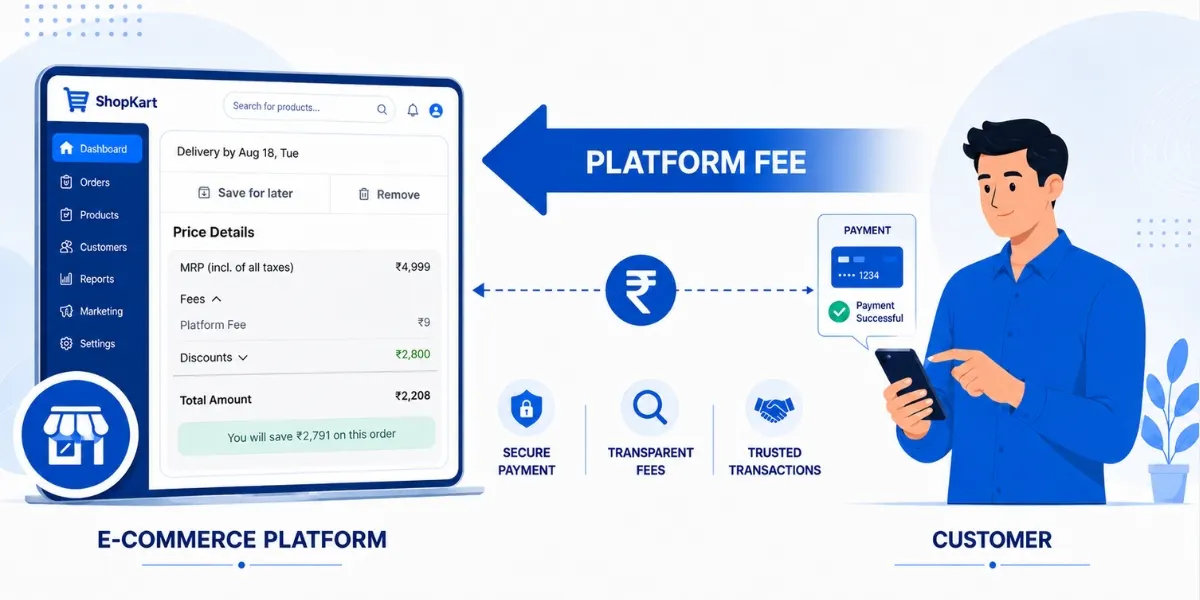
The Rise of Algorithmic Shopping
Remember when shopping meant opening an app, typing "black T-shirt", comparing 15 options and finally buying one?
Well… those days are slowly becoming history.
Today, your shopping app may already know that you like oversized T-shirts, prefer dark colours, look for discounts, and somehow mysteriously show you the exact product you were "just thinking about."
Coincidence?
Not really.
Welcome to algorithmic shopping where e-commerce is moving from "search and buy" to "discover and buy."
From Search Boxes to Smart Recommendations
Traditional e-commerce worked like this:
You search → You compare → You choose → You buy.
But modern platforms are increasingly trying to change that journey:
You browse → The algorithm learns → It predicts → It recommends → You buy.
Your previous searches, clicks, purchases, product views, wishlist activity, location, price sensitivity and even browsing behaviour can help platforms personalise what you see.
So if you searched for running shoes yesterday, don't be surprised if today's homepage suddenly looks like:
"Here are 27 running shoes you definitely need."
You: "I only wanted to check the price."
The algorithm: "Sure. And here's a discount."
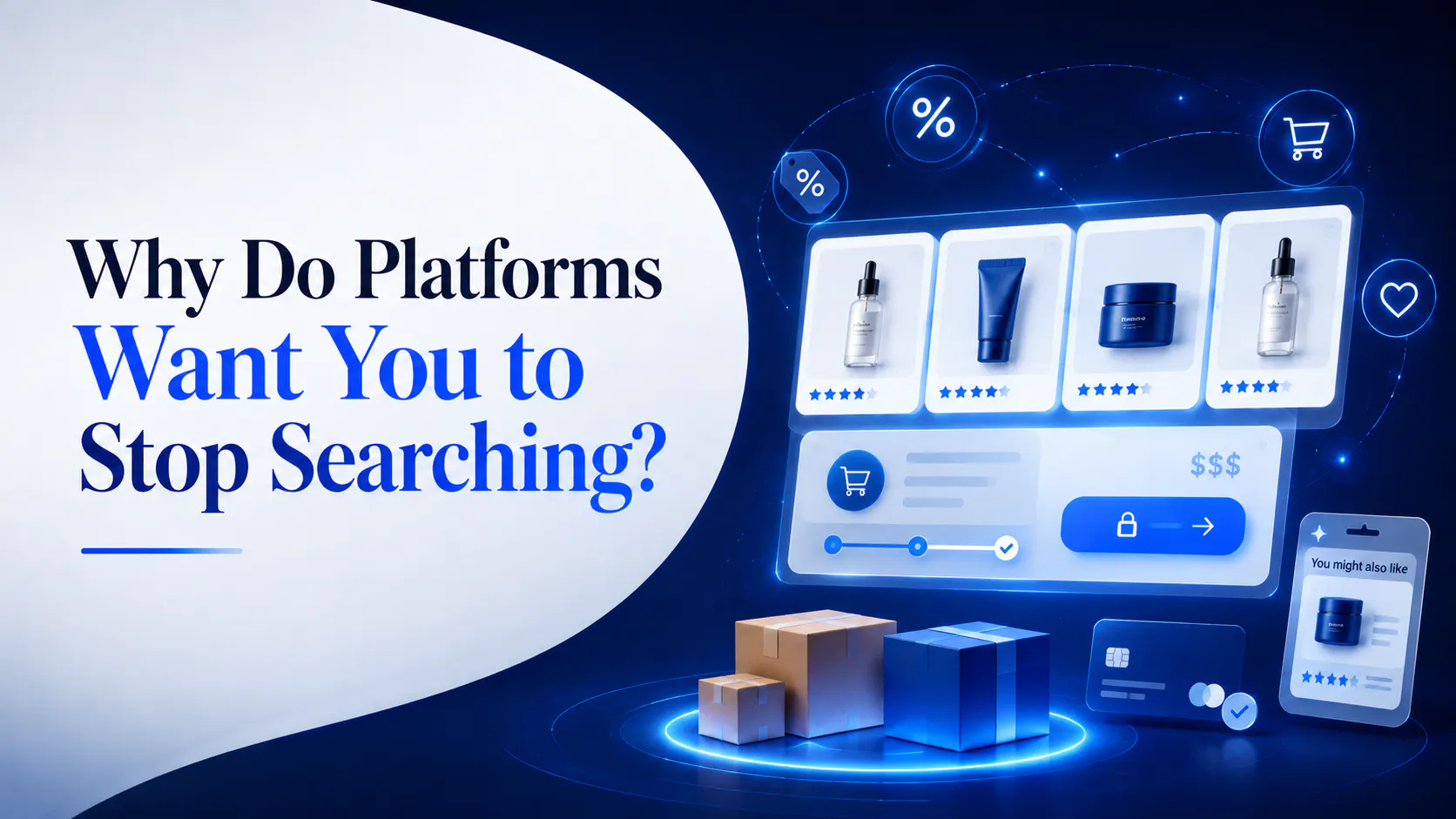
Because search is intentional, but recommendations can create demand.
When you search for "face wash," you already know what you want.
But when an app shows you:
- A trending skincare product
- "Frequently bought together" products
- A personalised recommendation
- A limited-time discount
- A product similar to something you previously purchased
…it can introduce you to products you weren't actively looking for.
This is one reason recommendation systems are so important to modern e-commerce.
The objective isn't simply to help you find products.
It is increasingly about helping you discover products you might want.
Your Shopping History Becomes Your Shopping Personality
Imagine two customers opening the same e-commerce app.
Customer A frequently buys premium skincare.
Customer B usually searches for budget skincare under ₹500.
They may not see exactly the same shopping experience.
Why?
Because personalisation allows platforms to make predictions about what each customer is likely to find relevant.
In simple terms:
Your past behaviour becomes a signal for your future recommendations.
That can include signals such as:
Clicks + searches + purchases + browsing time + wishlist + location + price preferences = personalised shopping experience
Of course, the exact data and algorithms used differ from platform to platform.
But the broader idea is simple:
The more you interact with a platform, the more information it can potentially use to personalise your experience.
Quick Commerce Took This One Step Further
E-commerce tries to answer:
"What are you looking for?"
Quick commerce increasingly asks:
"What else might you need right now?"
You order chips.
The app suggests a soft drink.
You order coffee.
It recommends cookies.
You order shampoo.
Suddenly there is a conditioner, hair serum and a ₹299 hair mask staring at you.
And somehow your ₹180 order becomes ₹999.
Was it shopping or a personality test?
Quick-commerce platforms are particularly interesting because the combination of speed, convenience, small baskets and frequent purchases creates more opportunities for recommendation-driven shopping.

Traditional shopping often had friction.
You had to:
- Decide what you need.
- Search for it.
- Compare products.
- Think about whether you really needed it.
- Complete the purchase.
Quick commerce can compress that journey dramatically.
You see something.
You want it.
It's available nearby.
It can arrive very quickly.
Purchase decision: 30 seconds.
And that's where recommendation algorithms become powerful.
A product doesn't necessarily have to convince you that you need it.
Sometimes it only needs to make you think:
"Hmm… why not?"
But Does Personalisation Actually Save Customers Money?
Sometimes, yes.
Personalisation can make shopping easier by:
- Reducing search time
- Helping customers discover relevant products
- Showing suitable alternatives
- Making product discovery faster
- Surfacing products based on previous preferences
But there is another side.
The same system that helps you discover a product can also encourage you to buy more products.
That's where consumers need to become smarter.
Because:
Personalised ≠ cheapest.
The product shown first isn't automatically the best deal.
The recommendation isn't necessarily the best product.
And a "Recommended for You" badge doesn't mean:
"Recommended by your financially responsible friend."
The New Battle Isn't Just for Your Wallet
Earlier, e-commerce platforms competed on:
Price + Selection + Delivery
Today, another battlefield is becoming increasingly important:
Attention.
If a platform can keep you browsing longer, discover more products and make the buying journey easier, it has more opportunities to influence what enters your cart.
This is why personalisation, recommendation engines, AI search and conversational shopping are becoming increasingly important parts of e-commerce.
The shopping experience is moving from:
"Tell me what you want."
to:
"Let me predict what you want."
So, Are Algorithms Shopping For Us?
Not exactly.
You still make the final decision.
But the environment in which you make that decision is increasingly personalised.
Think of it like walking into a physical store where the salesperson remembers:
"You bought this brand last month."
"You usually prefer products under ₹1,000."
"You liked this colour."
"Customers who bought this also purchased this."
Now imagine that salesperson following you 24/7.
That's essentially the direction algorithmic shopping is moving toward—only the salesperson is software.
What's Coming Next?
The next phase could be even more interesting.
Instead of typing:
"Best headphones under ₹3,000."
You might simply tell an AI shopping assistant:
"I need headphones for office calls, good battery life, comfortable for long use and preferably under ₹3,000."
The system can understand your requirements, compare products, shortlist options and potentially help you complete the purchase.
That changes the role of the customer.
You move from being a searcher to being a decision-maker.
And the platform moves from being a marketplace to becoming something closer to a shopping assistant.
Algorithmic shopping isn't necessarily good or bad.
It's a tool.
For customers, it can mean less effort and more relevant discovery.
For e-commerce platforms, it can mean better engagement, higher conversion opportunities and more personalised experiences.
But consumers should understand one simple thing:
The algorithm is designed to predict what you may want—not necessarily what you actually need.
So next time an app shows you a product and you think:
"Wow, this app knows me so well!" Pause for two seconds.
Ask yourself:
"Do I actually want this… or did the algorithm just make me want it?"
Because in the future of e-commerce, the biggest competition may not be between Amazon, Flipkart, Myntra or quick-commerce apps. It may be between your intention to buy and the algorithm's ability to influence that intention.
And honestly…Your cart might already know the answer.
Book a Free Consultation!
Ready to Win the Buy Box & Scale Your E-commerce Business?
Join sellers who are already building predictable, profitable growth.
✔️ Improve your rankings
✔️ Increase conversions
✔️ Build a sustainable e-commerce business
Let’s make your store work smarter not harder.
Free consultation • Fast response
Let’s discuss your growth plan
Share your requirements and we’ll suggest the best next steps for your store, ads, and performance.
- Store & catalog review
- Ads & ROAS audit
- Setup & onboarding
- Actionable roadmap
Prefer email? [email protected]