Every big company you admire started the same way: as paperwork.
Behind every funded startup, every brand that lands on Amazon, every business that raises money or hires a real team, there's a quiet first step most founders underestimate registering a Private Limited Company.
And here's the good news for 2026: the government has made it genuinely cheap, fully online, and faster than ever. What once took weeks of running between offices now happens through a single integrated form, often in under two weeks.
The catch? One wrong detail a rejected name, a missing document, the wrong authorised capital and your timeline (and budget) quietly balloon.
So here's the complete, no-jargon guide to doing it right the first time.
A Private Limited Company isn't just a legal status. It's the structure that lets you raise funding, offer ESOPs, limit your personal liability, and be taken seriously.
First, Why a Private Limited Company?
Before the "how," a quick "why." A Private Limited Company (Pvt Ltd) is registered under the Companies Act, 2013, and it's the go-to structure for businesses that want to grow.
The core advantages:
- Limited liability :- your personal assets are protected; you're only liable up to your shareholding.
- Separate legal identity :- the company can own assets, sign contracts, and be sued in its own name, separate from you.
- Fundraising-ready :- it's the structure venture capitalists and angel investors actually invest in.
- Credibility :- a Pvt Ltd tag signals seriousness to banks, clients, and partners.
- ESOPs and scale :- you can bring in employees, issue shares, and expand cleanly.
If you're building something you intend to grow, this is the gold-standard structure.
Who Can Register? The Basic Requirements
You don't need much to start the entry bar is deliberately low:
- Minimum 2 directors, at least one of whom must be a resident of India.
- Minimum 2 shareholders (they can be the same people as the directors).
- No minimum capital requirement — you can technically start with ₹1 of paid-up capital.
- A registered office address in India (a rented home works a commercial address is not required).
Foreign nationals can be directors, but at least one Indian-resident director is mandatory.
Documents You'll Need
Getting these ready in advance is what separates a 7-day incorporation from a 3-week headache.
For every director and shareholder:
- PAN card
- Aadhaar card
- One address proof bank statement or utility bill, ideally under 2 months old
- A passport-size photograph
- (For foreign nationals: passport with notarised/apostilled documents)
For the registered office:
- A recent utility bill for the address
- A No Objection Certificate (NOC) from the property owner
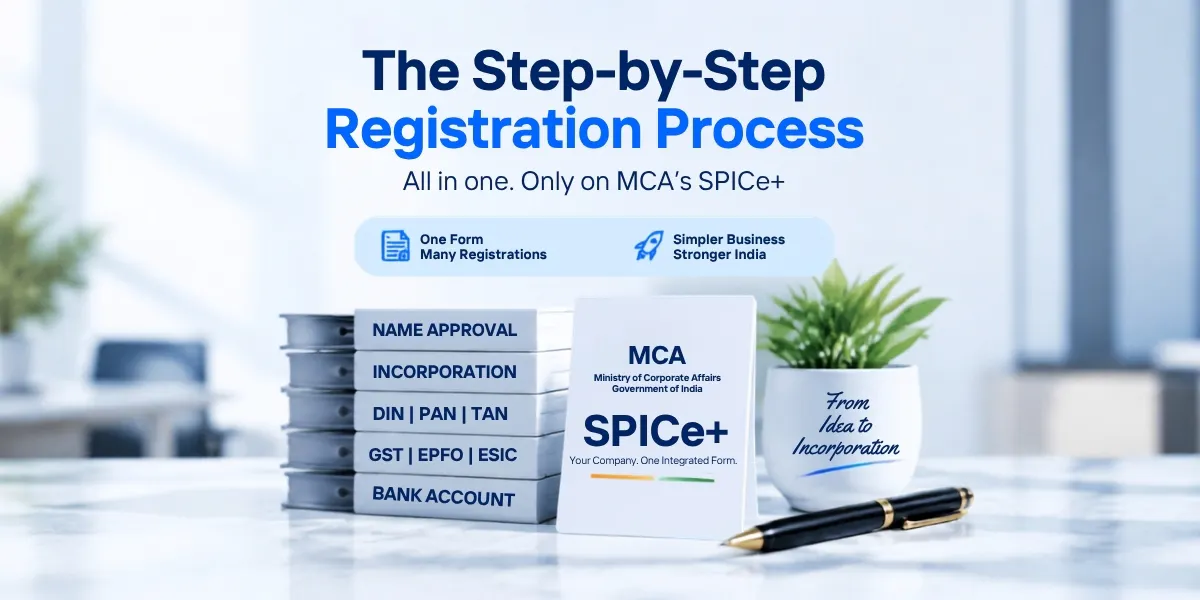
Everything now runs through SPICe+ (Simplified Proforma for Incorporating Company Electronically Plus) a single integrated form on the MCA portal that bundles name reservation, incorporation, DIN, PAN, TAN, GST, EPFO, ESIC, and even bank account opening into one flow.
1. Get a Digital Signature Certificate (DSC). Every director and subscriber needs a DSC to sign the electronic forms. This is your first step, since nothing can be filed without it.
2. Create an MCA portal account. Register as a Business User on the MCA portal this gives you access to the SPICe+ application.
3. Reserve your company name (SPICe+ Part A). Propose up to two names. The name must be unique and comply with naming guidelines. Approval typically comes in 1–3 working days, and an approved name is reserved for 20 days. (Tip: check availability first to avoid paying again on a rejection.)
4. Fill in incorporation details (SPICe+ Part B). This is the heart of the process capital structure, registered office, director and shareholder details, and your DIN (Director Identification Number), which can now be applied for right inside this form for new directors.
5. Attach the MOA and AOA. Your electronic Memorandum of Association (e-MOA) sets out the company's objectives; the Articles of Association (e-AOA) define its internal rules. Both are filed along with the form.
6. Complete AGILE-PRO-S. This linked form registers you for GSTIN (if applicable), EPFO, ESIC, professional tax, and a company bank account all in one go.
7. Pay fees and stamp duty. Fees depend on your authorised capital, and stamp duty varies by state. Payment is made online through the MCA system.
8. Receive your Certificate of Incorporation. Once the Registrar of Companies (ROC) verifies everything, you're issued a Certificate of Incorporation (CoI) complete with your CIN, PAN, and TAN. With clean paperwork, the whole process typically takes 5–10 working days.
Congratulations your company now legally exists.
What Does It Actually Cost in 2026?
The government has kept incorporation deliberately affordable, especially for small companies. Here's a realistic breakdown of where your money actually goes:
Digital Signature Certificate (DSC): Around ₹2,500 for each director and subscriber who signs the forms. For a standard two-director company, that's roughly ₹5,000.
Name reservation (SPICe+ Part A): ₹1,000 per application. If your first choices get rejected, a fresh application costs another ₹1,000 which is exactly why checking name availability upfront pays off.
MCA filing fee (MoA & AoA): Essentially nil for authorised capital up to ₹15 lakh you pay just ₹66 for PAN and TAN processing. The government genuinely wants you to register.
Stamp duty: State-specific, and the main variable in your total cost. It depends on your registered office state and authorised capital.
Professional fees: Optional, and vary depending on who handles the filing for you.
Put it all together, and most small companies spend roughly ₹7,000 to ₹25,000 all-in driven mainly by your state's stamp duty, your authorised capital, and whether you file it yourself or hire a professional.
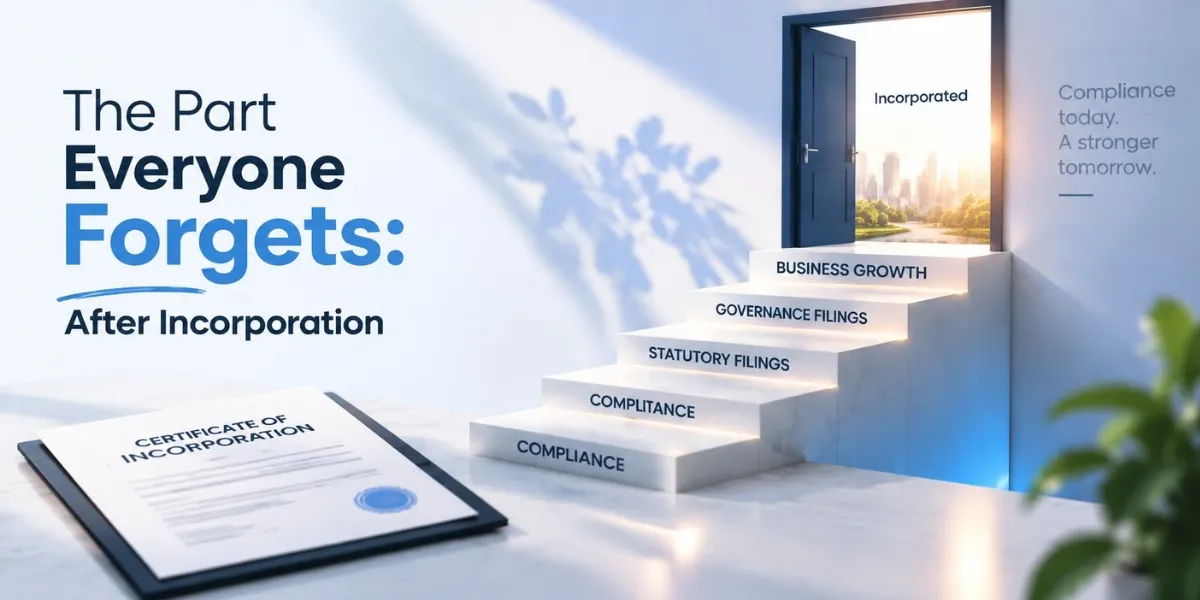
Getting the certificate feels like the finish line. It's actually the starting line.
⚠️ Incorporation is not the end of compliance it's the beginning. Miss these post-incorporation steps and you risk penalties of up to ₹100 per day per filing, plus possible director disqualification.
The key first obligations:
- File INC-20A (Declaration of Commencement of Business) before you begin operations mandatory within 180 days.
- Appoint a statutory auditor within 30 days of incorporation.
- Open the company bank account and deposit the subscribed capital.
- Stay on top of annual ROC/MCA filings, GST returns, and board-meeting records from day one.
This is where a lot of new companies quietly slip and where penalties start stacking up unnoticed.
How NextGen Helps You Register and Stay Compliant
On paper, SPICe+ looks simple. In practice, the small decisions are the ones that cost founders later: the wrong authorised capital that inflates your stamp duty, a name that gets rejected twice, an MOA with objects too narrow for where you're actually heading, or a missed INC-20A that triggers penalties before you've even made your first sale.
That's exactly where NextGen comes in. We don't just file a form we set your company up correctly for how you plan to grow, and keep it compliant long after incorporation:
- Company registration (Pvt Ltd, LLP, OPC & more) — end-to-end, from DSC and name approval to the Certificate of Incorporation, with the right structure and capital chosen for your goals.
- GST registration & filing — set up alongside incorporation so you're marketplace- and invoice-ready from day one.
- ROC / MCA compliance — INC-20A, auditor appointment, annual filings, and board records handled on time, every time.
- Accounting, audit & advisory — clean books, statutory audit support, and a clear view of your numbers as you scale.
- Ongoing compliance support — so you never lose a night's sleep over a filing deadline or a ₹100-a-day penalty.
You focus on building the business. We make sure the company behind it is set up right and stays that way.
The Bottom Line
Registering a Private Limited Company in India in 2026 is cheaper, faster, and more digital than it's ever been a single online form, nominal government fees, and a certificate in your inbox within a couple of weeks.
But the real value isn't just getting incorporated. It's getting incorporated correctly the right structure, the right capital, the right compliance from day one so your company can raise money, sign deals, and scale without hitting avoidable roadblocks.
Because the founders who win aren't the ones who registered the fastest.
They're the ones who built on a foundation that was solid from the very first form.
Book a Free Consultation!
Ready to Win the Buy Box & Scale Your E-commerce Business?
Join sellers who are already building predictable, profitable growth.
✔️ Improve your rankings
✔️ Increase conversions
✔️ Build a sustainable e-commerce business
Let’s make your store work smarter not harder.
Free consultation • Fast response
Let’s discuss your growth plan
Share your requirements and we’ll suggest the best next steps for your store, ads, and performance.
- Store & catalog review
- Ads & ROAS audit
- Setup & onboarding
- Actionable roadmap
Prefer email? [email protected]